Monday, March 12, 2012

dungeon world - - the Lichen Forest

So I'm now also game-blogging at myconidfighter.tumblr.com - - check it out sometime. I think the tone of that blog is going to be a bit more showcasy, and a bit less thinky, given that there isn't much of a story-games community on Tumblr as of yet, as far as I know. It's no G+, to be sure, so I'm not expecting reblogs and in-depth discussions. Hm, maybe I should just post on G+...

Anyway, last night was our first session of Dungeon World. I didn't know what to expect, but quite inadvertently we did some amazing stuff. We're using the Dec2011 preview version of the game, so our experience is probably a mashup of older stuff and things yet to come, but at least we have the v2.0 monster-making rules on hand, which tamps down the insane damage output a bit.

Anyway, so these rules don't have strong guidelines on prep; the first-session advice is basically "start with a tense situation. You'll build on it." Honestly, this really is about all you need - think about that alongside the Bonds questions (which illustrate connections between PCs) and you should have some vague ideas about the setting and about what could be going down in it.
In this case, I thought about their Bonds for a bit, and then resorted to targeted questions - - I asked the Wizard, Osmolord, to tell me, "What were you looking for in these woods, anyway?" He told me, "A place of power." That felt like a sufficiently Wizardly question; glad I asked it.
Then I asked the Ranger, Aranwe, "What's a creature that threatens these woods?" She told me, "That giant demon from Princess Mononoke, the one covered in worm-things." So I looked it up, tweaked it a bit in my head to make it more nature-y, and decided that when it attacks stuff it leaves sprouts and spores behind.

Boom! Gametime. The players have been sent to explore the ruins of a village destroyed by the monster. There is no sign of the villagers whatsoever; only furniture, tools, and the foundations of the houses remain - even the thatch in their roofs was gobbled up by the creature what did this.

So they take a sample of the spores and go back to the ranger's house, which she decided - very much on the fly - to be a cozy, dry cave underneath a big tree in the forest. There's a bio-luminescence theme in the forest, so I decided that elves use jars of water so they can bring glow-foam (glowing freshwater algae) home with them.

The spore sample caused the glow-foams to all freak out for a hot minute and glow bright red. Further study merited a visit with a local sage, Celion the Elf.
Celion had few answers, but he suggested that the reaction from the glow-foam could suggest that a) the spore-source is unnatural and evil and b) maybe it comes from the River of Lights?

So now that's a thing. The players spend the night at his place, and they fail their Make Camp check, so I decided to be a bit of a softie and have Celion's tree-home come to life and walk around while they're sleeping. They wake up just as it's starting to settle into a new spot, some miles west of where they started.

They bid a frightened, confused Celion goodbye and head to the River, where they capture one of the weird glowing jelly-creatures that lives in the water (very Miyazaki, imo) and see what happens when they place it (in a bowl of water) next to the jar with the monster-spores.
It freaks out and tries to claw out of the bowl, its little tendrils twitching in fear.
They relent and separate the two receptacles, but now they really think something ugly is going down. They send Aranwe's hawk-friend Apollo down south to try and spot the monster while they, up north, check out the River of Lights some more, and try to find its source up in the mountains.
That's about where we ended, and I left out some detail so as to present a more streamlined narrative.

Mechanical thoughts:
-Making monsters is a blast with the v2.0 rules! They still do too much damage, but maybe I just need to reframe my expectations of level-1 characters.

-I totally forgot to make the Wizard roll to cast his spells. I'm still giving him the XP, though, as he did use Intelligence (which was highlighted).

-I haven't quite figured out what kind of communication ability the Ranger is supposed to share with an animal companion (can they talk, or does that require Wild Empathy?), but the Command move (much like the Apocaworld Driver's relationship to his car) lets the Ranger get big stat bonuses by incorporating her companion into the action - for instance, you add its Ferocity to your melee rolls when you fight together - - this led to a sweet +4 bonus on a Discern Realities check!

-It looks like it'll be slowish going with XP and leveling. I think combat is probably going to be a good source of XP, though, and honestly I didn't mind the current (non-BBC) stat-highlighting procedure, but it may end up being useful to explore other options.

-The fact that casting a spell counts as a move means that you can highlight your magic-stat and reap lots of XP that way. It is a bit of a risk, of course...

-If anything, I think the Fronts are more comprehensible to me now than they were with Apocaworld, partly because I'm putting less pressure on myself and partly because I'm more familiar now, but also there's an element of "duh, of course!" when designing Dangers. I do miss the more abstract/conceptual options AW presents, but I'm okay with having the human Mayor count as a planar force - construct of Law on the basis that his impulse is, indeed, to "eliminate perceived disorder".

-I'm trying rilly hard not to get ahead of myself with Campaign Fronts and Dungeon Fronts (I don't quite understand these yet - - I think the latter carry the presumption that play will be dungeon-centered, but that's a big if). Basically, I think DFs are for contained or limited-area threats that are directly challenging the players because of their current situation, while CFs are for broader "motive forces", like the movers and shakers of the setting or the world.
I think the best, biggest asset to making Fronts in DW is the very simple, focused ethos behind them: what would happen if the players weren't around to be heroes? Since DW characters are supposed to be problem-solvers, this makes it very easy to have thoughts like "the elves and humans would go to war" or "the Mayor will declare martial law" or "the monster will destroy most of the farming villages before it can be killed".

In AW, I found it more challenging because I didn't inherently see the players as being good guys - they were just around, and even though RPG expectations and even genre expectations were a factor, I didn't point the NPCs quite directly enough at the players in conflict. I eventually got the hang of it, but there was definitely some disconnect early on, with NPCs just doing their thing and almost ignoring the players. But that's going too far (for my purposes) in the direction of creating a world that exists for its own sake, and not enough of creating a world while exploring what the players are up to.

I think that once my AW players started to feel like it was their world to conquer, things got much more interesting, but at first I was acting like the players would break the setting if it tried to come up and talk to them. I feel a lot more competent with it now, and our DW game will get to reap the payoff on that. Session 2 is tonight, and we have a third player joining us! What will he play, I wonder?

Friday, March 9, 2012

Dungeon World gems, pt. 1

so in Dungeon World, there's a little gem tucked away in the Cleric section (p34):
"Once a spell is granted the Cleric can cast it. When a spell is cast
it may be revoked by the deity. A revoked spell is no longer granted
to the Cleric and can not be cast until the Cleric Communes and
asks for it again."

So - - let's ponder this for a second. Clerics have lost heavier armor in DW (it counts as Clumsy for them, but not for Fighters), and frankly items like poultices, bandages, and so on really give Cure Light Wounds a run for its money - bandages in particular restore 4hp, while CLW only heals 1d8 (not all that much more, tbh).

But Clerics get a boost from that line "may be revoked by the deity". Not just a power boost, potentially, but that one small sentence means that the DM has a clear, concrete way to comment on a god's current feelings towards its loyal servant. You can also be weird and mysterious by revoking certain spells but not others.

At the same time, this is a challenging, fiddly bit of decision-making to embark on - - the DM must remember her principles and abide by them very carefully. Be a fan of the PCs. It's possible that a god could be punishing its disciple by revoking spells, but if so, the DM should make that clear in other ways so the player can address it. If the god is instead micromanaging, then hints or clues about the "mission" the god thinks the Cleric is on right now would be useful.

Don't think about what you're trying to do to or for the player with revocation. Think, in the fiction, what the deity is trying to do to the cleric.

Friday, March 2, 2012

frogs

Last night, I played a little Labyrinth Lord.
I rolled up some ... stats that didn't really fit anything other than a) mediocre thief or b) crappy wizard. So, thief it is!
I reprised my role as Otto Lampblack, but this time around apparently, he is a neutral-good two-spirit individual who worships Frigga, making him something of a rarity in his very butch, Vikingesque hometown of Hommlett.
Yep, classic adventure called The Village of Hommlett - it's the prelude to the Temple of Elemental Evil, apparently.
So! Frogs. We ended up only having time for one encounter, and it was against four giant frogs - 3 the size of dogs, and one the size of a horse. Kind of terrifying, especially when the big one swallowed our dwarf whole. The rules were, "Roll d20 each round. 18+ frees you. You get three tries, and are then digested." Yikes! The dwarf succeeded on his 2nd try, and apparently that kills the horse-frog and results in a 100gp amethyst being found in the frog's belly.

I have never given a frog-related high-five before, but you only get so many opportunities ^__^ Since I'm working on a Labyrinth Lord adventure myself, this was a good experience of the game and what it's like to play. Frankly, since it's OSR, it doesn't have a huuuge difference from other OSR joints I've encountered (like S&W) - it's kind of like all OSR games I've seen (minus Lamentations, which I haven't played yet) are about as different as the daytime vs. nighttime Denny's menu - lots in common, but just some different peripheral options.

Friday, February 17, 2012

the material conditions of fudging

So I was just thinking, when you're running a game, why on earth would you ever fudge the dice or check your swing?
I think part of the blame lies in the module system, and here's why:

- if a module is mainly about the puzzles and the monsters, and not about a story (least of all a time-sensitive one), then players are just there to be challenged and clever and explore lots of stuff. They die? Then I guess they aren't good enough, mwah haha! A challenge here for the DM is to think about what content is likely to be experienced and what content is likely to remain hidden or unknown - - you don't want to put too much work into an amazing set of traps if it's unlikely the players will choose that path in the first place.
[- - Being able to re-visit a given dungeon can reduce the "unseen content" factor, but of course in one-shots and the like, this just isn't a realistic goal]

- OTOH, if a module has a strong component of setpieces (things that are time sensitive and maybe sort of "mandatory" to get the "full experience"), then there's an incentive to make sure at least some of the players survive long enough to see them. And if we put our fancy hats on and try to design puzzles or "experiences" that require a certain minimum number of (living) players, or a particular class is required for some reason to get through it, then the DM is going to feel that much more of a squeeze to let everyone live, always.
[- - Setpiece-focused design is all about the performance. It's like being on a ride! Ultimately, the priority of showing off the module's content supersedes the priority of no-holds-barred exploration. When you start to figure out that the DM isn't going to let you die, it changes the dynamic, and not always for the good.]

You know which side of the fence I'm on! But that doesn't make it any easier - just because you're committed "ideologically" (so to speak) to a particular play ethos doesn't mean you can just snap your fingers and make it happen - apparently that takes practice.
Cases in point:
1- I didn't really think very tactically about how to play Ishigiri the Ogre Mage (homebrew: Dwarf Troubles Lv 1), and instead of him using his 1/day cone of cold on the healer, he used it on a henchman. The dice roll was pretty epic, nonetheless: I ruled that, due to extreme overkill, the henchman's feet broke off and remained frozen to the floor while the rest of his icy corpse went skidding along the tunnel, only to shatter against a door.
2- I did make sure that people had appropriate warning about the pit trap in the opening hallway (homebrew: Lair of the Cyclops Lv 1) - - "the floor's creaking", "the dwarf senses a trap", etc. Once you are given a warning, and you keep walking on the creaking tile floor, it's on your head ^___^ There's a trick to it - imo, in order to be a reasonably likable and trustworthy DM, you can be cruel, disgusting, and vicious, but only insofar as you have established reasonable credibility (a highly localized phenomenon) regarding your ability to be fair.

What is fair? I think it's a fairly simple matter of establish-then-execute. AW & DW talk a lot about this: do what the fiction demands. How do you know what it demands? Well, kid, the MC/DM moves tell you what you can put into the fiction and when, but the players do a lot of that for you and you just wait til they screw up a dice roll.
Creaking floor? OK, the pit trap is good to go.
Glowing eyes? The cultist's magic powers are good to go!
In the case of Ishigiri, I think a frost theme around his lair could have signaled that that's one of his signature powers. That, or fog-breath, or something. Hints like that are big, loud, alarm bells to the veteran adventurer, and something subtle really can establish your credibility enough (adventurers like to blame themselves for dying...)

Tuesday, February 14, 2012

gm style flowchart/eulogy for a PC

Yes, this chart has some age to it. but you don't come here to read new ideas, do you? haha
The full image doesn't fit in this space, but the format in that link there is pretty good.

[below is x-posted at Story Games also]
So! Different topic: last night's AW session. One of our protagonists died.
Keep in mind that this PC was nicknamed the Ronin, took potshots at Mudflat villagers kind of "just because", and never fully backed down from a fight, not once.

Let's explore this a little more. His name was Rue Wakeman, a Gunlugger. He had bad, bad scars from when his boss, Diamond the Chopper, beat him up and left him in the desert, where his wounds went bad and exposure did its thing, and made him really hard to look at.

He lived in a drainage tunnel that fed a semi-toxic river outside of Adobe-town; hallucinogenic mold grew inside the tunnel, which Rue ate to open his brain to the Maelstrom. Doing so got him in trouble a couple times, like the time the Mudflatters finally arrested him for deadly assault and he ended up thinking his captors were dog-headed monsters serenading him, so he shot one and ran away.
The guard lived, but only just. Thanks to Boo the Angel on that one, I think.

Anyway. So Rue forged his nemesis when he was walking past the Mudflatter work-camp in town (across the river from the Mudflatter village of Northside) and a couple of guys stopped him to ask if he'd be up for making a little money.
Rue: Sure, what's the job?
Roy (Mudflatter): There is a ... forgive me, but a child we wish for you to assassinate [the playgroup started telling John, Rue's player, that this must be a reference to Dr. Last, a semi-immortal warlord from down south whose current form is that of a 6yo boy.]
Rue: A child, huh?
Roy: Regrettably, sir. Will you take the job?
Rue: *shoots Roy* No.

Roy's friend runs away. When Rue is eating, later that night, Roy and two buddies jump him. Rue manages to kill two of them and send Roy packing again, but this time the Mudflatter camp all saw what happened and formed a big old gang to hang him and put an end to this.

Ol' Rue got away that time, but after Diamond's boss, Havok, ate it in a gunfight down south (Boo got him), and things started to settle down a bit, Rue made the error of robbing some Mudflatters playing dice in an alley. Well, Rue had been sleeping in the desert for a bit, ever since the first near-lynching incident. Now that he was back, and they sure knew his face, about fifty Mudflatters got together to stop him for good.

They chased him out of town, throwing rocks. The elder of Northside sees what's going on, sees Rue's defensive counter-fire, and sighs. He was in the middle of a visit with Diamond and Vega (the Operator, old boss of Adobe-town), and apologized before giving the order for the village guards to shoot Rue on sight.

Diamond: Honestly, I helped him get out of town last time a mob came after him. I'm done.
Vega: He'll probably be okay.
Elder: ...

So the gunmen from the village go charging out into the desert, and soon enough they intercept the mob and a tiring Rue. He turns to lay a little cover fire before taking off down a nearby dune, and flubs the roll. So he doesn't get away, and they get him with small arms fire (2-harm; Rue has 2-armor), and he rolls a natural 11 on the +harm move.
I tell him he's incapacitated.

Right before Rue dies, A. (playing Vega) turns to me and says, "Is Rue gonna die? That's harsh."
Me: "I mean, it's what the fiction demands. I have mixed feelings about it, but I can't not do it."
A brief discussion of "be a fan of the PCs" vs. "look through cross-hairs" ensues.

This is when I get a little nervous. I've hardly killed any PCs in my time, so I feel kind of bad. I describe Li, one of the Mudflatters, a guard who's got a thing for Vega, coming up and delivering the fatal back-of-the-head shot himself. He then goes to throw up.

Later, we're packing up to go, and John (ex-Rue) says, "Maybe I'll play a Faceless next. I really want to do something that's noticeably different from Rue, though." Clearly I got worked up over nothing. I did have to sit with it for a couple of hours (I have anxiety; what can I say?) but I got over it, and Lord knows, John got over it in about sixty seconds. Next week, onward and upward!

Wednesday, February 1, 2012

tolkien and class politics

[inspired by a Michael Moorcock essay on the success of the nursery-rhyme motif in the fantasy genre, found here]

Orcs are the working class. The Tory vision of the working class, at any rate.

While hobbits and Men and Elves and Dwarves all come from storied ancestry and can recount the names of their forefathers and the grand halls (or grand burrows) from which they hailed, Orcs have no fathers. Orcs have few names, and of course the Black Tongue is nasty, brutish, full of short, sharp sounds.
Orcs toil; we never see the Free Peoples toiling, except for a bit of farming now and again.

Orcs build. Orcs make engines that spurt flame; Orcs raze whole forests and dig deep, disgusting pits where they breed! Orcs, ironically, are the only race of Middle Earth whose breeding habits are put (mostly) on display; they are the only race that is growing, that is rising, that is gaining in strength. All around them are declining princes and listless civilizations. The Orcs have plenty of room to expand, and their industrial masters are happy to oblige.

Now, on the one hand there are a great many literary devices wrapped up in Orcs that make them easy to dislike, especially in the films: they're smelly, slimy, cannibalistic, unpredictably violent, and vaguely simian. Tolkien, at once, rolls dark skin, primate features, and spontaneous generation (they apparently "grow" in pits and come forth fully muscled and fully grown) into an altogether unpleasing whole.

At the same time, many fans of the trilogy find a certain pleasure in Orcs: they are dangerous, they are serious, they wear the coolest/scariest outfits, and they hang out with Wizards who do more than light fireworks and talk to bugs.

But again, Orcs are Tolkien's very Tory image of the working class. They're a dark-skinned, foreign-tongued horde of builders and soldiers and ruiners who eat anything and everything, are a threat to all (even themselves), and, most tellingly, are constantly under the yoke of powerful, singular demagogue intellectuals who dwell in not-quite-literal Ivory Towers.
Compare that to the Istari, who are angels in the shape of old men (a creative choice I can't recall seeing anywhere else but in It's a Wonderful Life). One Istari in particular is deeply fascinated by the middle-class, status-obsessed Hobbits of the Shire, and seems to like nothing better than spending time in their twee, half-size pavilions and houses and so forth.

The Orcs come to despoil the natural world, and cannot stop themselves. Their actions are not truly their own; truly, Tolkien's chief Enemy is the future, industrialization, science; Orcs, not being exactly scientists (beyond an offhand comment that they "made many clever things, but no beautiful ones"), are nonetheless the Industrial Army, ready and willing to build, destroy, and kill in the name of hated Progress.

While pretty much every major character among the Free Peoples is the descendant of some king, the Orcs, as I said, breed in holes in the earth. Ironically, Tolkien has painted us a world where dark-skinned, violent humanoids would probably be called Mudbloods if the opportunity came up, and in which the Wizards must save us all from the dangerous, disgusting creatures of the earth that seemingly live only to breed and to build. Old men in hats will save us from those dirty workers, wot wot?

Tuesday, January 24, 2012

Apocalypse World, session 9ish::

so Diamond the Chopper leads his gang and his friends to the city of Bluesquare, to confront his employer, the warlord Havok.
and by confront i mean kill. there's a big old battle in and around the town hospital - - we see some fancy gunplay, diversions, and decoy tricks from Rue the Gunlugger. Diamond drives his gunjeep right into the hospital lobby, and runs dudes over like Brock Samson.
Boo the Brainer (former Angel) uses a six-gun and a little psychic force to corner Havok in the darkened upper level of the hospital, where zhe shoots him and his bodyguards dead.
it doesn't really sink in until they're burning the corpses of Havok's crew that anyone thinks to ask, "So, did we kill Havok back there, or what?"

i laugh (they've been hunting this guy for like 6 sessions, and then he dies almost off-camera) and nod my head.

somewhere in there, Diamond opens his brain to the weird to find out how the good townspeople are holding up after all the carnage, and he rolls like a 3. he pops, taking 1-harm (ap psychic silent). he becomes semi-vegetative for a little while, very suggestible but generally calm and mindless for about 30 minutes or so.
around that point, what's left of his gang appoints itself a new leader named Clarion (sarcastic blond dude). the gang goes home to Adobe.

anyway, it's a few days later and Diamond is living down in the city instead of up in the fortress. and he's ok with that. returning late one night, the gate-guards pretend not to recognize him, and he doesn't get mad. an anthropologist in a scramblesuit (he is known as a Shifter) comes by to interview him about, you know, stuff.

Diamond's player, Biff, has taken upon himself to become a sort of commie paladin - - he never starts a fight, he set up communal medicine and food supplies in Adobe, and he ruthlessly crushes saboteurs and opportunists. now that he isn't in charge, he's trying to fill out every last improvement slot in his playbook before he's forced to retire, and he plans to watch the new boss (that Clarion guy) like a hawk until then.

Friday, December 2, 2011

i'm so excited about our apocalypse world game!

- Diamond, the Chopper, just picked the advance "get a holding (detail) and wealth", meaning that sleepy, spy-ridden Adobe Town is gonna become a bustling city soon, and that's the coolest!
- Biff, owner of Diamond, is gonna take over as MC sometime soon. I get to be a player soon! yayyyy
I need to decide between:
Battlebabe
Driver
Hocus
Not sure which I want. Maybe make a sample pc of each and see what the haps.
- Vega, the Operator, has joined our ranks. She's an ex-Hardholder hoping to get back at her former lieutenant, the infamous Lord Havok.

more to come! this game rocks :)

Thursday, December 1, 2011

Re: Callan, snakes and ladders

I assumed that Ron meant something like, "following the carrot of reward [in whatever game he was talking about; i forget] does not actually incentivize exploring the game further."

In Chronica Feudalis (a historical-medieval adventure game that stole Aspects from the FATE system), there are only two sources of currency or character improvement. One of them involves Aspects: if you let your character's Aspects be turned against him/her, you get a reward which can only be spent to activate OTHER Aspects, yours or that of the scene (like weather and stuff) or that of other characters.
So, it's basically a zero-sum game for the players: every time they let themselves be kicked around a bit, they can do the exact same thing to someone else. It's all very GM-led (the GM has infinite Aspect tokens), and this isn't to say it's not fun, but you don't really change or develop from this - you're just poking and prodding at what's in front of you. Pure Exploration of character and situation, no inherent moral or ethical dimension at all (so no "native" support for Narrativism), and honestly the fact that the GM has infinite Aspect-tokens (or whatever they're called) means that there's no way in hell this game is "battle-tested" as a good supporter for Gamist play, as GM/player competition is hopelessly one-sided -- the GM can spam your Aspect: Self-Defeating til the cows come home.

So - second reward system: skill training. This one is actually a very different sort of Simulationist logic - - while Aspects are actually a pretty neat way to chew the scenery and Explore being a medieval person, skill training relies on the logic of "game-system-as-physics" - that is, the idea that the rules must accurately reflect the way cognitive, physical, and institutional processes *actually function* inside the game-world.
Going off to a trainer does fuck-all to add to your Exploration of being a medieval person other than to give you ... Exploration of what it's like to go to school as a medieval person. Given that there is very little focus as to what one "does" in Chronica Feudalis, I suppose a game that centered around training facilities, or at least featured them meaningfully, could play to the game's apparent natural points of focus. But this is meeting a good-but-uninformed design a good deal more than halfway :)

[EDIT: my bad! Turns out I had only read the advancement rules about halfway through. Here's how it works:
1- you train with a mentor or by yourself, turning one of your skills into an "in-training" skill.
2- you go out and use that skill in a scene "where something is at stake" (quoth the rules)
3- either make a skill check for that skill, or make a skill check of your trainer's skill - - ChronFeud skills use a die-step system, so your skill's rating is in the form of a d-whatever. Thus, improving a d6-rated Swordsmanship skill would require a 6 or higher on whatever skill check you use, so training with a.. trainer who is better than you would make more sense than training alone, especially when you get to higher levels of ability.
4- once you successfully improve a skill thus, it is no longer "in training" until you do this all over again
I admit, that actually makes some good sense, from the perspective of a Sim-style "game-rules-as-game-physics" approach.]

At this moment, it seems that I have a much better idea of what Reward Systems are: they are the system's internal structures that encourage you to play the game a certain way (design intent made manifest). If you want to play the game a different way, it usually goes one of two ways:

1- the game fights you, actively hampering your ability to play the game you were "hoping for". Such games cannot be Drifted without extensive reworking of existing rules. White Wolf games come to mind; I'm no fan of the Humanity system, the Paradox system, any of it, because it doesn't do what it's trying to do in a way that actually helps me explore the themes I see lying dormant in that content. Sorcerer does Humanity better by a country mile than Vampire could ever hope for.

2- the game just lies there, forcing you to bring your Creative Agenda with you in a suitcase, so to speak - that is, the rules are open or sparse enough (in terms of what CA you were hoping to engage in) that you can work entirely on the level of the fiction to make things happen. That is, in the case of ChronFeud and Narrativism, if you write up a few leading questions for PC creation in order to tease out a Kicker or two and some intra-party juiciness, you can use these answers (much as Apocalypse World does) to "kick off" play in the right direction for what you want. AW, however, does it a fair sight better in that it combines the leading questions with a LOT of tools for the MC to keep things moving. Without those tools (present in the system or present in the group's skillset), there may be a fair bit of difficulty keeping things going once the initial "steam" of those Leading Questions runs out.

[EDIT: despite my corrections above, I stand by this second point, here. The only thing that the training system adds to the game is a sense of explicit, in-fiction cause and effect for improving your character's abilities. Many, many other games get by just fine without approaching char-improvement in this way, even games that are "fiction-first" like Apocalypse World.
I think a group's time and energy are better spent paying such close attention to the consequences of their actions with regard to the fiction and its internal "logic"; I know that this attitude reflects my own play priorities, though, and if you like this sort of thing, go for it, but I will politely decline any invitation to join in ^__^]

Sunday, November 27, 2011

Reward systems - are we getting anywhere, or..?

Thinking about this thread at the Forge, which mentioned RPG "reward systems".

I think a reward system could be a "hamster wheel" if the way to earn gimmes and Currency doesn't actually encourage people to engage in the point of the game, nor encourage them to "drive towards" it. Basically, your Exploration of the game system should promote the Exploration of "what play is all about" (be that competing for glory in Agon, or wading through moral quandaries in Dogs, or making tough choices in ApocaWorld) by-way-of Exploring character, setting, and situation.
For instance, some games have it so that the rules for advancement (a common avenue for Exploring the game system) are detached from the "presumed" content of the game - - maybe you MUST seek out a trainer in order to improve your abilities, but the majority of the game is dungeon-crawling, far from the academies and gymnasia (where the trainers are), then people have to go outside the normal fictional "play space" in order to "earn" the encouragement to buy into the activities of the game.
"Gold=xp" editions of D&D have a pretty clear, intentional reward cycle, especially if you can't level up until you leave the dungeon: you need to explore "efficiently" and try to use all your cleverness and care to maximize your gold-haul and minimize your exposure to danger. Dungeon crawling, using gold=xp/exit-to-levelup, is different than dungeon crawling that's defined as kill=xp/levelup-down-here. Not better or worse, but one is more of a puzzle game with a combat element and the other is more like a combat game with a puzzle element.
Specific reward systems do more than just encourage Creative Agenda; they also encourage a particular taste or style of play. Each reward system has its own particular take on elements like competition, exploration, and theme, serving as different varieties of play of a particular sort.
In D&D0e, the emphasis is on coordination, detail-inspection, and careful rationing of resources. We could say 0e rewards Attention to Detail.
In Agon, the emphasis is on inter-player competition, individual acts of heroism, and exciting, bombastic command of resources. We could say Agon rewards Chutzpah.
These are related types of gaming, but they are nonetheless distinctive enough (due to their respective systems and the style thereof) as to make playing them each a very different experience.
Polaris vs. Dogs in the Vineyard is good, too - - in both games, your character is powerful and in a position of authority. But the crushing weight of world's end (in Polaris) means that, logically, to advance your character is to hasten the apocalypse - - you have to lose Zeal and gain Weariness to get better on your dice rolls. Each advancement pushes you closer to the end of the game. You can avoid this by being "weaker-willed" against the Demons - - be more agreeable with your Mistaken, more willing to compromise and let things go, and you will last longer. But you will also be giving the Demons more of a foothold in your world. Fighting your battles is the only way to prove your worth, but fighting ALL battles only hastens your inevitable doom. Sort of a gloomy, Ragnarok take themes of fate and destiny.

Meanwhile, in Dogs, your character is always right. People may disagree and try to block the execution of your judgment, but you know they're just demons or idolators. The big question that helps to twist this theme is: how far will you/must you go to get your way? You have to be very tactical when crushing heresy, all the while wondering if you really deserve the authority given to you - - sometimes your judgments ruin lives unfairly. It's much like running an actual religious institution: handling dissent and disagreement proportionately, deciding how many administrative resources to dedicate to handling a problem, and of course wondering all the while whether any of it is worth it, ultimately.
Huh.

Saturday, November 19, 2011

settlers UNLEASHED!

Biff and I started joking around about capitalism during a game of Settlers tonight, and after the game we hashed out some ideas about how to play as the humble peasants of Catan instead of their lords and masters.

- Each player keeps track of two hands of cards: their own and their king's hand. A player can only use resources from their own hand, not from their king's hand. The game itself plays the role of the kings.
- Each turn, each city OR settlement in your color produces one resource-unit from each adjacent hex.
- Next, roll the dice, as usual. Whatever number is rolled, hexes that would normally produce will instead "eat" one resource of the appropriate type from your hand - this resource goes into your king's hand. Call this "tithing". Cities, though, eat two resources of each type from your hand.
- If you roll a 7, you can place the Robber on any hex you like; any player with a city or settlement bordering that hex takes one random resource from their king's hand and puts it in your hand.
- Each turn, check your king's hand to see if it can afford to buy any development cards. Buy all the development cards you can afford (using the king's hand only!) and play them as soon as possible (your next turn, I think). Lumber and bricks just sit in the king's hand (you must trade them with the bank or any available harbors, in order to collect as much wool, ore, and grain as possible - for development cards!)
- Development cards that award resources are instead tithed by that player to his or her king's hand. Those that award victory points work normally.
- When Knight cards are played, they are placed under the Robber's new location; this hex now produces nothing, but demands tithes when its number is rolled, and upon Robber-placement, a random resource is taken from an adjacent player's own hand and put into your king's hand. When the Robber changes locations again, such Knight cards return to the corresponding King's hand.

Not sure how victory points factor in or how I'd want them to be different. What I'm going for is some kind of end-goal of turning a city into a "free republic" a la the Italian Renaissance.
Help me develop this :)

Thursday, November 17, 2011

Sunny the RPG

Been thinking about It's Always Sunny in Philadelphia, and how to realize it as an RPG.

Some elements:
- the gang tries to come up with a plan or scheme, usually in order to get one over on somebody. Let's call this The Plan.
- each member of the gang will attempt to push the scheme in a direction that benefits them most, even at the expense of their friends. Let's call this Taking Advantage.
- getting one over on a friend or someone else seems to give the gang more control over further events: once they've demonstrated their (temporary) superiority to someone else, they tend to keep having success with their endeavors for a while (til random chance smashes it all to pieces in some absurd or contrived way... say, this DOES sound like an RPG!). Let's call this Value - you have to demonstrate it. Value is a currency for getting your way more effectively.
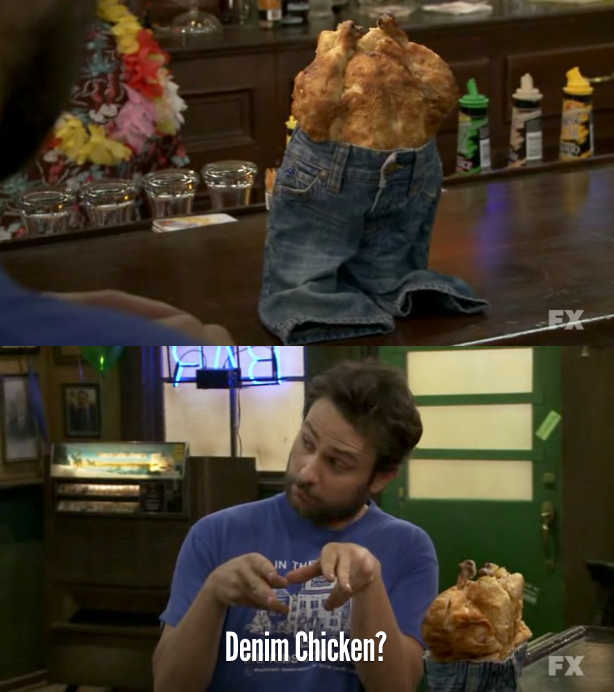
- it does seem, though, that someone with Value can use it for others, if they wish. I see absolutely no reason to stop players from doing this; clearly it's exactly what was going on with the Denim Chicken.

- Of course, if the Plan starts having setbacks, you can always Take Advantage of a fellow gang member in order to regain Value, and drive the Plan back in the direction you want.

Hm. I'm guessing that Keys would be an excellent way to represent the different characters - each of them is about projecting a certain desired persona, and in turn having short-lived moments of fallibility or selflessness for comedic or dramatic effect (usually just comedic, like in Mac's Project Badass tapes).

I think this basic idea could be ported over to other "Cast of Bastards" style shows - as in, a comedic ensemble cast whose members are antagonistic towards each other, yet affiliated with each other in some fashion. In Sunny, the affiliation is that they run a bar together; in Arrested Development, the affiliation is familial.

Goals would probably be a useful device for establishing the interests of protagonists - goals could be short-term and temporary, or long-term and earnest, ranging from the Sunny gang's fleeting financial investments, to Tobias's Queen Mary, to, I dunno, Bender's commitment to boozing and whoring at any chance (though Futurama falls more into the category of pratfall comedy/comedy of errors, with only one Bastard among the protagonists [hint: he was built in Mexico]).

There might be Talents also, which are both the problem-solving appoach a character takes AND things that a character could spend Value on to achieve success. So... Mac could pummel someone, whereas Dennis is more of a scheming, cackling manipulator; Charlie is better at getting into weird, cramped spaces, while Dee is pretty good at fast-talking people.
You can go outside your archetype (and use other people's Talents) by spending Value. If you describe yourself using someone else's Talent without spending Value, they might get a bonus against you - - George Sr. is pretty much a master of teaching people lessons, and usually gets the final word in these sorts of situations.

Hm. Giving this serious consideration...

Sunday, November 13, 2011

What Story Now play looks like

So I feel like play-style is a pretty stable thing; I, for one, will pick a relationship, goal, or situation in play and charge at it, hands outstretched, in order to get a good grip and squeeze drama out of it.

Relationship? No one can tell this person what to do but me! This way, interacting with him/her will be charged with potential conflict.
Actual play example: [game: Storming the Wizard's Tower][my character: a fisherman, father to a (secretly) pregnant shepherdess] The blacksmith's apprentice is my daughter's best friend. She knows about the pregnancy, and (out of character) says as much aloud.
Best part? I made a Charged Conversations roll, then asked, "Is my daughter actually pregnant? Is that the truth?" GM thinks about how to respond (since I was asking about something a player said, not a character. Yes, quibbling is a big part of what RPGs are about ^__^), and then says, "Yes. She is." I really liked knowing something as a player, but not as a character, and having the dramatic irony give off an awesome vibe.

Situation? I will seek the origin of the curse upon your house, and later we will ret-con that I actually placed the curse, myself! Hahaha! Now, there is another twist in the emerging situation, and it pits us against each other in a bad-blood way. Cool!
Actual play example: [game: Polaris][my character: a Knight of the Stars who is a skilled male midwife; tasked with concealing the deformed byblows of another noble house] The women of the House of Corvus, it is whispered, give birth sometimes to reptilian monsters that do not live beyond birth. It's my job to dispose of them discreetly. Then, one day, when I'm burying one in the courtyard, I discover a lizard-figurine buried in the dirt that's just stinking with dark magic. (I enter this element into the story because it seems like a fun answer to, "Why is House Corvus cursed?")
The sages inspect the thing, and determine that it is, indeed, the source of the curse. Another of the Knights (a fellow player), cynically suspecting treachery on my part, narrates, "Sir Fornax moved the curse-lizard from the courtyard of his own House into ours. He means to push his own line's barrenness onto the Corvus clan!" Ha, well, I didn't challenge this assertion using any Key Phrases, and decided it was just too awesome a twist to turn down.

Goal? I will pick the worst (best?) possible moment for my quest to conflict with yours, so as to achieve delicious drama.
Actual play example: [game: Exalted][my character: an Abyssal (a champion of death) who truly believes in the purifying power of Oblivion] My master, a Deathlord, is uninterested in anything but his own consolidation of power. When this means fighting other Abyssals instead of banding together to spread our dark power, I rebel, flee the Deathlords, and throw myself on the mercy of the Solars (champions of the sun, my people's implacable foes) rather than serve a lord without integrity.

Note - Exalted lacked any direct means via the rules (explanatory text about background and setting is not "rules" in the normal sense) for me to address theme in the way that I wished. On the other hand, if goals/relationships are not tied closely to the game system in some way (explicitly, or emergent in play), it can be tough to find your "way in" to that. My character was pretty crappy with the dice rolls in this last example, so really the only recourse I had was in my allegiances, not my actions, in play. I wasn't blocked from exploring Theme all on my own, but it would have been a lot more satisfying if character creation had gotten other players thinking in this direction, too.

Bottom line: rules can't stop you from playing as you wish, but if you follow them, they sure can help with a particular style. You can tell pretty quickly (during character creation, maybe; definitely in play) whether the game is working with you or against you. Is the game too creatively demanding for your tastes? Does it get lost in the "fluff" instead of who wins and who loses? Is it too creatively constraining? Lots of things can go wrong; playing a game that seems to "get" your style is an extra-awesome experience.

Friday, November 4, 2011

tales of Apocalypse World: Red Front

I used to think that a couple of my AW players were being really passive in our game, but I was reading this thread about passive players, and it occurred to me:

- my players seek to avoid conflict, yeah, but they're doing it because it's true to their characters. It's kind of impressive: the tunnel-rat Gunlugger only leaves his hidey-hole if anyone bothers him, and if they do, he shoots them dead with his 4-harm high-powered rifle. The Angel, who wears a scramble suit and does hir doctor's rounds for the town every single morning, wants absolutely no trouble or discord with anyone, ever. Zhe makes no enemies, holds no grudges...
In short, they're both a real test of my ability to tease out scarcities that matter (so there's conflict), but it could be a lot worse: they could decide that I'm trying to give them "cues", and then they would try to follow them.

It actually came up kind of directly, the other night: Rue the Gunlugger's player, John, joked that obviously Boo the Angel should follow the biker gang to the local warlord's citadel, because, "It's the RPG thing to do, right? Go check out the big city, you know, explore a little?" Still, he did mean it in jest, and when Boo's player, Valery, just laughed and carried on trying to avoid any conflict with the townspeople, it was clear that she felt no such pressure, or at least was resolute enough to ignore it.

I love playing with people who don't have mainstream-RPG baggage ^___^

Monday, October 31, 2011

The Istari are some kind of angel-wizard light beings who like to smoke up

This is a taste of what I'm working on. Can you tell I just re-read the Hobbit?
That book was largely impenetrable to my 12-year-old brain, but my 28-year-old brain has fallen head over heels in love.

Sunday, September 25, 2011

[AW] Adobe Town, session 3 highlights

Highlights from tonight:

1- Diamond the Chopper, plus most of his gang, bring a shipment of salvaged steel parts to the stronghold of his master, Havoc.
They enter the gates, set aside their weapons, and bring the shipment to the ... garage. Havoc has claimed, and kept up, a McMansion circa 1995, complete with two-car garage, linoleum flooring, and Redskins commemorative plates on the mantle.
So, a bunch of hard-bitten, neofeudal bikers, chilling at a couple of card tables, checking out the particle-board cabinetry and chintzy wallpaper. Loving it.

2- So, three farmers from the Mudflats creep up into the huge concrete drainage pipe where Rue the Gunlugger sleeps. They want revenge after he pointed a gun in their mate's face the other night, over a matter of someone treading barefoot on a misplaced hypo.
Rue wakes up in their grip, gets his machete free of its sheath, and kills the first of them. The others scream and run, and he picks them off with his rifle.
More farmers come to investigate, as does Diamond and his gang. There's a bit of a standoff, but as soon as the village elder Do gets a good look at the bodies, he screams and cries for vengeance. One of the farmers, a fellow named Rum, breaks and runs, while the rest charge the bikers with staves and scythes in hand.
Diamond's gun is knocked away, but he grabs a club from a farmer, and starts giving as good as he gets. Rue lets off a couple rounds to scare the lot of them, and the elder gets them to back down in the face of overwhelming arms.
Boo the Angel pops in to tend to the dead, and manages to bring one of them back to life and health. While the cowed farmers are carrying their friend home, Rum (remember him?) comes running back with a six-gun in hand. Diamond grabs iron and tells him not to shoot, "What's done is done. You've no quarrel with us now."
Rum shoots anyway, and notches Diamond's armor. The Chopper shoots back and blows off the man's shootin' hand, which sets the crowd on him all over again until the elder Do clubs two men with his staff and screams, "No more blood, you fools!"
Boo goes and sees to Rum's bloody stump, and a second, final truce is reached, at last. Phew!

Wednesday, September 21, 2011

Ode to an Apocalypse World NPC

To Mimi.
Mimi, you crazy, crusty-haired junkie. You threatener of men's balls, you dropper of needles where others will step on them, barefoot.
I love you, dude. Don't change.

Love, your MC

Thursday, September 15, 2011

I would recommend that, if you play Hot Guys Making Out, the uke or receptive role should not be taken up by someone who is uncomfortable with male homosexuality.
Just. Saying.
You'd think this kind of thing would be obvious. -__-;;

Wednesday, September 14, 2011

This. The CAs' whole purpose is to help you see, not the diversity of your own play, but the diversity of possible play, including, most importantly, play that makes you go "ugh,so not a fan." Or, "but ... how is that even fun?" Or, "sure, but that's not roleplaying."
Thanks to Vincent for reminding me why Creative Agenda is really not a big goddamn deal. In hindsight, the wild, poisonous, contentious, sometimes productive debates about CA/GNS, sweeping the 'nets every once in a while, are basically an argument about whether or not there are different ways to role play, and to enjoy role playing.
It's super important that one take the time to play lots and lots of different games, figure out what we like (a broad or narrow range, whatevs), and then play those games.
I have played a lot of boring games, a few games I hated, and an increasing number of games I love. CA is one way* of talking about how they differ; it happens to be very difficult to explain in the abstract, not so hard to grok once you've played games that support very different Agendas.

So, I intensely dislike Exalted-the-game, even if I'm a bit of a fanboy for Exalted-the-setting. I absolutely adore Apocalypse World and Kagematsu and Polaris; I'm pretty sold on My Life With Master and Dogs in the Vineyard. Sorcerer is neat, Swords & Wizardry is a lot of fun, and A Penny For My Thoughts is a good time.
I'm the most interested in games that draw a lot of their structure and concepts from the way that narratives work (the precise medium being imitated is irrelevant). Games that are all about problem-solving, detailed questions, planning, etc. (dungeon crawls, f'rex!) are fun too. Overall, I most-highly value games that are focused, that have a highly intentional design ethos, and that push me into an emotional space that I'd have a hard time recreating on my own. Seriously, I've cried during sessions of Polaris and MLWM, and AW has gotten me misty-eyed a number of times. I love that kind of stuff.
Basically, it all comes back to actual play. Play games, find out what you like, what you love, and what you hate, and keep up with the good stuff! Life is too short to play games that aren't any fun.

Saturday, September 3, 2011

Reflections on the One Ring RPG

Thanks to the .pdf being so readily available, The One Ring RPG already has dozens of pages of comments in forums like Story Games and rpg.net, so there's already a lot out there to look at.

I've gotten hold of the .pdf myself (and will, yeah, most likely buy the boxed set), and I have to say, I'm really excited about this game!
A few comments and quibbles:
- yes, there is a passing similarity to Mouse Guard, but not a strong one.
- yes, the formatting is such that particular rules can be a little tricky to find at times, but if you read it from beginning to end you'll find everything; some things just aren't repeated like they should be, or are first mentioned in odd places and then never mentioned again (like what the Feat die and Success dice look like..)
- I have been underlining all kinds of things, just to overcome the semi-weird formatting; things that look important but aren't flagged and bolded have been underlined or circled in black pen (thanks, b/w printout!)
- you roll a d12, the Feat die, every time you roll the dice. If it comes up an 11, it's the Eye of Sauron, which negatively affects the result. If it comes up 12, it's the Rune of Gandalf, which has a positive effect. Kind of wonky that they went with 11 instead of, you know, 1, but whatever. Strictly speaking (I need to investigate this), it could be that the Eye still counts as an 11 but also creates bad or weird side effects. Still, kind of odd.

Straight-up cool stuff:
- adventures occur at the rate of one per year, followed by a recovery period called the Fellowship Phase in which you manage your reputation, your wealth, and your spiritual health (by shedding Shadow points); this phase lasts between a week and a season, and "caps" the adventure.
For context, the journey from the Shire to Rivendell could be considered one adventure, since they take their sweet time healing Frodo, something on the order of weeks!
The journey to Mount Doom, come to think of it, would be one enormous adventure from there on out, since the poor hobbitses never really get a break after that. Maybe I'm just recalling the movie version of events, though. Merry and Pippin catch a bit of a break when they encounter the Ents and get a chance to rest up at the Enthall, though.

- corruption! Okay, so I'm not quite sold yet on the cool-factor of gaining Shadow points from traveling through tainted lands, but experiencing anguish and doing horrid things to others both seem like legit sources of Shadow points. The latter, especially, is reminiscent of Polaris and its Experience Tests.

- to remove Shadow taint from yourself, you must make a Craft test or a Song test. Yep, just like in Earthdawn, making beautiful things is how you free yourself from the taint of evil. Cool! (okay, okay, in Earthdawn, strictly speaking, making beautiful things is how you prove that you are free of evil's icy grip, rather than how you remove yourself from it. Close enough ^__^)

- the game is set about five years before "the shadow returns to Mirkwood". Given the time-frame mentioned above, that means you've got about five adventures ahead of you before the War of the Ring's first blow will be struck (that is, the ringwraiths capturing and torturing Gollum, and finding out where the One Ring is). Naturally, that means the players have five game-years to walk into the Shire and encounter Bilbo Baggins and, who knows, maybe hear a little tale about his magic ring...

- the text is chock full of little story-gamey gems that demand a close-read. Yes, this game is in the Trad Games tradition (in that Trad rather than Indie is where the creators have been hanging out, where they got their experience and inspiration, etc.), but it's got neat little things in it like:
"the player shall declare the intended result of his action. On a success, he narrates what occurs," [paraphrased from the text]
and
"When a player selects the skill he will roll to complete an action, and when he describes the action itself, the other players shall have veto power over these decisions for the sake of logic and theme. If the players cannot resolve the issue, the Loremaster [GM] shall make a ruling." [paraphrased from the text]
To be fair, there are also depressing little tidbits like,
"...nothing ruins a good session of play as [much as] a player questioning the Loremaster's knowledge of the source material" p. 7, Loremaster's Book
and
"Before the game begins, the Loremaster should have at least a generic idea of how the plot of the adventure should unfold.... The Loremaster needs to have an idea of when [the events of the plot] will happen." p. 13, Loremaster's Book
So, yeah, you get some of the standard stuff about "The GM makes the plot, and the players are its main characters", (Google the "Provisional Glossary" and search for the phrase "Impossible Thing Before Breakfast" for more context).
To be fair, if the LM cannot "barf forth Tolkien-style apocalyptica" to the players' satisfaction (lil Apocalypse World reference, there), then the LM probably shouldn't be LMing. It's kind of neat that the rules explicitly state that the person best qualified to LM is whoever knows the most about Tolkien in the group, so at least they offer a method of handling this head-on. ^__^
Secondly, there is absolutely nothing wrong with pre-game prep. What I find objectionable is outcome prep, rather than simply content prep. Any veteran GM will tell you they've written up all sorts of amazing things on their lonesome before a session, only to never quite get a chance to use them in play. Understandably, the outcome/content distinction is not made explicit here.

Additionally, there are really neat little rays of light poking out, indicating that the designers were of two minds about player autonomy, which is cool:
"The last thing a Loremaster should do is to restrict his players ... in order to make them conform to his idea of how the game should progress. Players must feel that their characters can attempt any action, no matter how limited the chances of a successful outcome." p. 7, Loremaster's Book

Additionally, along the same lines:
"Managing the game system properly is absolutely vital for the creation of a truly cooperative role-playing experience....nothing is more destructive to a player's suspension of disbelief and immersion in the game than the feeling that his [hero's] fate is being dictated by the Loremaster's choices and not his own." p. 17, Loremaster's Book
Really! How cool is this?
Following up is this:
"... the rules are not the province of the Loremaster alone, but are an invaluable resource to be shared with all participants." p. 18, Loremaster's Book [emphasis mine]

Basically, you have what appears to be, and seems to be largely received by players as, an ordinary adventure-journey game that, thematically, takes D&D full circle into explicitly Tolkien-themed waters. But, clearly, there are elements of player empowerment, and a few gems here and there in the Corruption rules, that demonstrate it can be something more or different or stranger than that.

I didn't even mention character creation stuff, or Encounters!
To sum up the cool bits super-quick-like, there are several opportunities to plug your character concept into a larger context: many of the Backgrounds you can choose from (which actually determine more about your character than the character-class-equivalent, "callings") explicitly mention family members, social status, and community ties, right there in black and white. Lovely!
Now, of course, connecting your character's odd, unpleasant, or strange Background to, well, the rest of the game... the trick is to take it with you! That's going to take the GM's assistance. For example - Tookish hobbits are not trusted, considered wild, unpredictable, and adventurous. So - should the GM simply have a few NPCs mutter about your Tookish features, clucking their tongues?
No way! See, the biggest mood-killer for building Theme and whatnot, I think, is obsessively making the game about the traveling. The Journey mechanics really don't need to be front-and-center; they aren't even that complicated, so you could use kind of like a complicated AW custom move to further stress the scarcity and danger of Middle-Earth.
Additionally, Encounters are reserved for dealing with single or grouped (friendly or neutral) NPCs that you meet on your travels; the GM reserves judgment for deciding what constitutes an Encounter, but it puts a bit of emphasis on making such things significant in some way. The part I find the most compelling is this: all PCs have virtues (valour and wisdom), and NPCs look at one or the other virtue to decide how well they regard you.
The value of the chosen virtue dictates how many failed dice rolls the party can make during the Encounter before the NPCs decide they've had enough of your bungling. Things like racial prejudice (yep! In the rules!) and your characters' social standing (especially with the culture the NPC(s) belong(s) to) all affect how many of your failures they will endure. If you reach their Tolerance (that's the game term, yes), they will basically decide they aren't interested in listening to or dealing with you further - - what that means in detail is rooted in the direction the fiction is taking.
It's like taking the old-timey D&D reaction roll and expanding its scope to include a whole scene, rather than just a random little die roll at the moment of encounter.

Lots of cool stuff. I'm working on getting a campaign going. We'll see what comes of it!